

 Facebook
 X
X
 Pinterest
 Copy Link
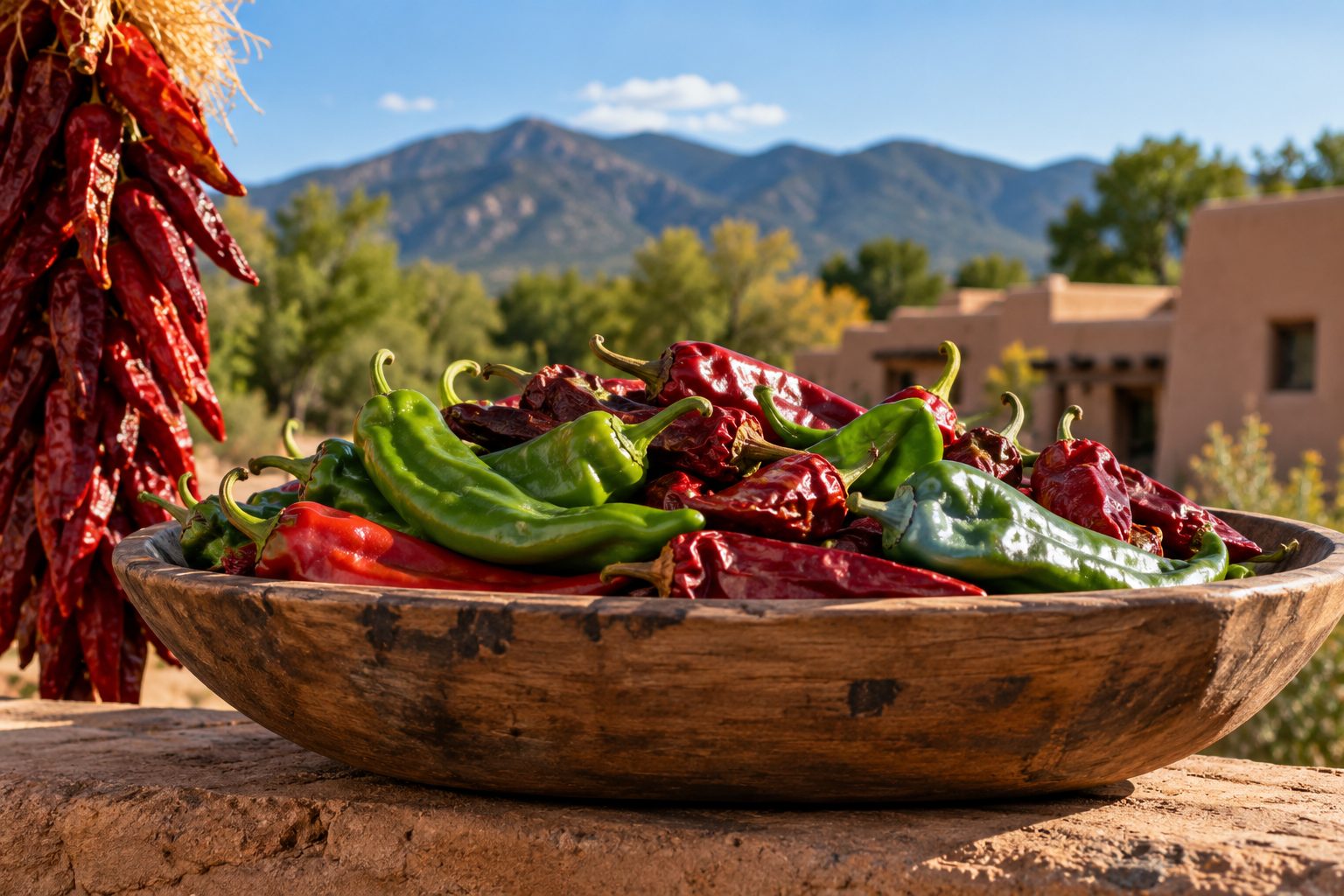
In late summer and early fall, there are few surer signs of the season in New Mexico than the smell of green chile roasting. You find it outside grocery stores, at farmers markets, along roadsides and drifting through neighborhoods as people bring home sacks of freshly harvested chile.
That aroma is so closely associated with life here that New Mexico made the smell of green chile roasting its official state aroma in 2023.[1] But the relationship between New Mexico and chile goes back much further—more than four centuries, shaped by Indigenous and Hispano agriculture, generations of local seed saving, and eventually the work of agricultural scientists who helped turn a regional crop into an industry.
Chile Arrives in New Mexico
Chile peppers are native to the Americas and were cultivated for thousands of years before Europeans arrived in the Western Hemisphere. By the time the Spanish entered what is now New Mexico, chile was already an established crop farther south.
Exactly when it first reached New Mexico is less certain.
Surviving written records indicate that Spanish explorers introduced chile seed to New Mexico by the late 1580s, before the establishment of the colony in 1598. But long-established trade networks connected Pueblo communities in the Southwest with peoples farther south, so chile may have reached the region before the Spanish. New Mexico State University notes that the historical evidence leaves open both possibilities.[2]
What is clear is that chile was being grown here by the beginning of the Spanish colonial period—and over the following centuries, New Mexican farmers made it distinctly their own.
How Chile Became New Mexican
Growing crops in northern New Mexico requires adaptation. The elevation is high, nights are cool, the growing season is relatively short, and water has always been precious.
For generations, Pueblo and Hispano farmers saved seed from chile plants that performed particularly well under these conditions. Seed came from ripe fruit that matured before the first freeze and from plants that survived the particular environmental stresses of the region. Those seeds were planted the following year, and the process continued from one generation to the next.[2]
Over time, that created what are known as landrace chiles: plant populations that have become adapted to a particular place through generations of selection and seed saving.
Northern New Mexico still has a remarkable collection of them. The best known is Chimayó chile, named for the village north of Santa Fe, but historic landraces are also associated with Alcalde, Velarde, Jemez Pueblo, Tesuque Pueblo, Cochiti Pueblo, Santo Domingo Pueblo, Zia Pueblo and other communities.[2]
These aren’t simply old varieties with different names. Research at New Mexico State University has found northern New Mexico landraces to be genetically distinct from the commercial New Mexican-type chiles widely grown today. They also tend to have smaller, thinner-walled fruit and earlier maturation—traits particularly useful in northern New Mexico’s shorter growing season.[2]
It’s an important distinction in understanding the history of chile here. There isn’t one ancient variety called “New Mexico chile.” What developed instead was a collection of locally adapted chiles, cultivated and preserved by individual families and communities over generations.
Fabián García and the Birth of Modern New Mexico Chile
The next major chapter in the story began around the turn of the 20th century with Fabián García, a horticulturist at the New Mexico College of Agriculture and Mechanic Arts, now New Mexico State University.
At the time, the chile grown by New Mexico farmers could vary considerably from plant to plant. Pod size, shape and heat weren’t particularly predictable—fine for small-scale farming and household use, but a problem for an emerging commercial food industry.
García set out to change that.
Beginning in the late 19th century, he experimented with selection and crossbreeding to produce a chile with larger, smoother and more uniform pods and a more dependable heat level. His work eventually produced New Mexico No. 9, released in 1913.[3]
It was a pivotal development. New Mexico No. 9 established the genetic foundation for the modern New Mexican pod type and helped make commercial processing of chile practical. All New Mexican pod-type chiles grown today trace their genetic base to cultivars developed through García’s pioneering work at NMSU.[3]
NMSU’s chile breeding program continued from there, eventually producing familiar cultivars including NuMex Big Jim, Sandia, NuMex Joe E. Parker, Española Improved and New Mexico 6-4.[4]
The university’s influence on chile has become so extensive that NMSU now operates the longest continuously operating chile breeding and genetics program in the world.[4]
What About Hatch Chile?
One of the most common misconceptions about New Mexico chile is that “Hatch” describes a particular variety.
It doesn’t.
Hatch refers primarily to where the chile is grown, not to a single cultivar. The Hatch Valley in southern New Mexico produces several varieties of New Mexican-type chile. Big Jim, Sandia, Joe E. Parker and other cultivars may all be sold as Hatch chile when grown there.[5]
That’s different from a name like Chimayó, which can refer to a traditional landrace associated with that northern New Mexico community.
The distinction helps explain why two sacks of “Hatch green chile” can differ in size, flavor and heat: they may not actually contain the same cultivar.
Red or Green?
For anyone new to New Mexico, here’s another useful piece of chile knowledge: red and green chile generally aren’t two fundamentally different kinds of pepper.
They’re different stages of maturity.
Green chile is harvested while the pod is still green. Leave the fruit on the plant and, as it ripens, it turns red. That change in maturity also produces two different culinary traditions.
Green chile is typically roasted, which blisters its tough outer skin so it can be removed. The roasted chile can then be chopped, frozen or used fresh in everything from stews and enchiladas to eggs and cheeseburgers.
Chile allowed to ripen fully turns red and can be dried. Those dried pods can be ground into chile powder or rehydrated to make red chile sauce. They can also be strung together into the ristras that appear on portals, walls and storefronts throughout Santa Fe and northern New Mexico.
Same fruit, harvested at a different point in its life. Two very different expressions of chile.
How “Red or Green?” Became the State Question
Eventually, chile became so closely associated with New Mexico that the state turned a familiar restaurant question into an official symbol.
In 1996, the New Mexico Legislature declared “Red or Green?” the official state question, referring to the choice New Mexicans routinely make when ordering chile with a meal. [6]
Of course, there is a third answer: Christmas—both red and green.
Chile had already been designated one of New Mexico’s two official state vegetables, alongside the pinto bean, in 1965.[7] Then, in 2023, New Mexico became the first state in the country to adopt an official state aroma: green chile roasting.[1]
For anyone who has spent a September in Santa Fe, the choice isn’t difficult to understand.
A Living Agricultural Tradition
What makes the history of chile in New Mexico particularly interesting is that it isn’t confined to a museum or history book.
The two strands of that history continue side by side. Commercial growers cultivate modern varieties descended from more than a century of agricultural research and breeding. At the same time, families and communities in northern New Mexico continue growing landrace chiles descended from seed selected and saved over generations.
Around Santa Fe, that history becomes tangible every harvest season. Fresh green chile arrives at markets and roadside stands. Roasters begin turning. Red pods appear in ristras. Families buy chile by the sack and put it away for the year.
More than four centuries after chile became part of New Mexico’s agricultural landscape, it has become something much larger than an ingredient. It carries the history of the people who grew it, the communities that preserved it, and the landscape that shaped it.
And every fall in Santa Fe, you can smell that history roasting.
Sources
[1] New Mexico Secretary of State — State Aroma. New Mexico adopted the aroma of green chile roasting as its official state aroma in 2023.
https://www.sos.nm.gov/about-new-mexico/state-aroma/
[2] New Mexico State University Cooperative Extension — The Landrace Chiles of Northern New Mexico. Stephanie Walker and Charles Havlik, Circular 679. History of chile’s introduction to New Mexico, traditional seed saving, northern New Mexico landraces and their characteristics.
https://pubs.nmsu.edu/_circulars/CR679/
[3] New Mexico State University — The Chile Cultivars of New Mexico State University, 1913–2022. History of Fabián García, New Mexico No. 9 and the development of the New Mexican pod type.
https://pubs.nmsu.edu/_circulars/CR706.pdf
[4] New Mexico State University — The Chile Cultivars of New Mexico State University Released from 1913 to 2016. History of NMSU’s chile breeding program and cultivars developed by the university.
https://pubs.nmsu.edu/research/horticulture/RR792/index.html
[5] New Mexico State University Chile Pepper Institute — Then and Now. Explanation of New Mexican pod-type varieties and the use of “Hatch” for chile grown in New Mexico’s Hatch area.
https://cpi.nmsu.edu/chile-info/then-and-now.html
[6] New Mexico Secretary of State — State Question. History of “Red or Green?” becoming New Mexico’s official state question in 1996.
https://www.sos.nm.gov/about-new-mexico/state-question/
[7] New Mexico Legislature — New Mexico State Legislature Handbook. History of chile and frijoles being adopted together as New Mexico’s official state vegetables in 1965.
https://www.nmlegis.gov/Publications/Visitors/StateLegislatureHandbook14.pdf