

 Facebook
 X
 Pinterest
 Copy Link
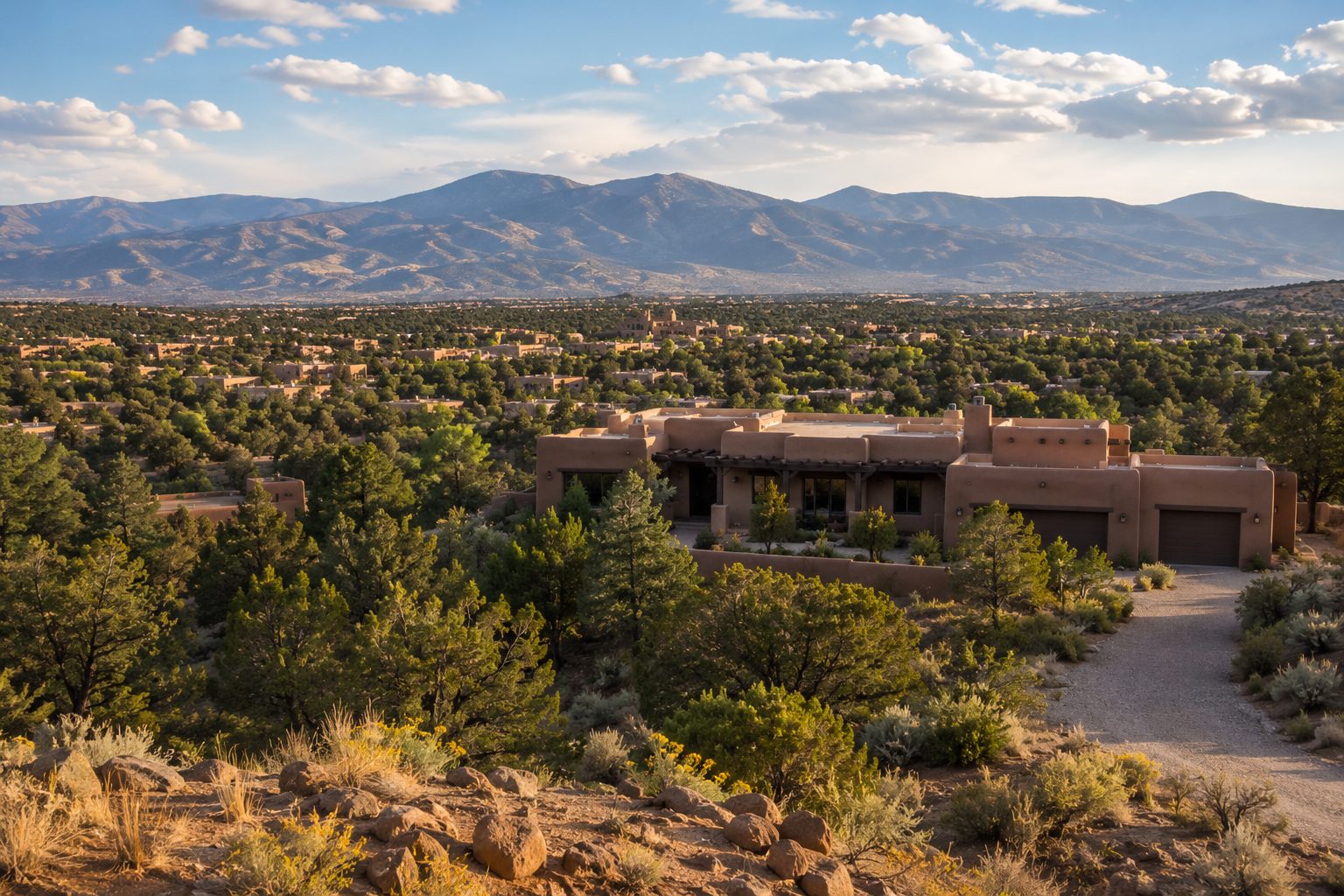
If you’re considering a move to Santa Fe, one of the first distinctions worth understanding is one that isn’t always obvious on a real estate listing:
A Santa Fe address doesn’t necessarily mean a home is in the City of Santa Fe.
Drive ten or fifteen minutes from the Plaza and you can move between properties inside the city limits and properties governed by Santa Fe County without feeling as though you’ve left Santa Fe at all.
For a buyer, however, that line on the map can matter.
City and county properties can differ in utilities, lot sizes, roads, zoning, development rules and the practical responsibilities that come with owning the property. Neither is inherently better. They simply offer different versions of living in Santa Fe.
Understanding those differences early can make your home search considerably more focused.
First: What Do “City” and “County” Actually Mean in Santa Fe?
The City of Santa Fe sits within Santa Fe County, so technically every home in the city is also in the county.
When people in local real estate talk about a property being “in the county,” though, they generally mean unincorporated Santa Fe County — outside the municipal boundaries of the City of Santa Fe.
That includes an enormous range of properties and communities. A county property might be a contemporary home on several acres, an older adobe in a traditional village, a horse property, a house in a planned community or something that feels remarkably suburban.
So don’t equate “county” with “remote.”
Likewise, don’t assume a Santa Fe mailing address tells you which side of the boundary you’re on. The City of Santa Fe maintains a GIS map specifically for determining whether a property or roadway lies within city limits.
For buyers relocating from elsewhere, this is one reason we prefer to evaluate individual properties rather than make assumptions based on an address alone.
The Biggest Difference May Be the Amount of Land Around You
One of the clearest reasons buyers look outside the city limits is space.
Within much of the City of Santa Fe, you’re choosing among established neighborhoods where homes are relatively close together. Depending on where you look, that might mean a historic compound, a conventional residential lot, a townhouse or condominium, or a newer planned development.
Move into the county and considerably larger parcels become much more common.
For buyers coming from dense metropolitan areas, this can be one of Santa Fe’s great revelations: you may be able to have substantial separation from your neighbors while remaining within a reasonable drive of downtown.
But acreage changes the equation.
A larger parcel can mean privacy, views and room for horses, gardens, workshops or additional structures. It can also mean more land to maintain, longer driveways, different utility arrangements and more questions to answer during due diligence.
The right question isn’t simply “How much land can I get?”
It’s “How much land do I actually want to own?”
City Utilities Aren’t Universal Once You Leave the City
For many buyers coming from larger cities, municipal water and sewer are simply assumed.
They shouldn’t be in Santa Fe.
City of Santa Fe water service primarily serves properties within its established service area, and the City does not automatically extend water service to additional properties outside that boundary. City properties accessible to the municipal sanitary sewer system are generally required to connect when they are developed or improved.
Outside the city, the picture becomes much more property-specific.
Depending on the location, a county home may have:
- a private well
- a shared or community well
- a community water system
- a septic system
- public or private utility service
- some combination of the above
None of these should automatically disqualify a property.
They do, however, change what we want to investigate before you buy it.
For a home with a well, for example, we want to understand the well itself rather than merely note that one exists. With septic, we want to know the system’s age, characteristics and whether the property’s current configuration is adequately served by it.
Santa Fe County specifically notes that adding a bedroom can require septic-system approval, and development of a water-supply well requires authorization. Those are the sorts of details that can become important if your plans extend beyond simply living in the home exactly as it exists today.
What You Want to Do With the Property Matters
Suppose you find a beautiful county property on five acres.
You start imagining a guest house. Or a studio. Or horses. Or a large addition. Or perhaps subdividing the property someday.
The acreage alone doesn’t tell you whether any of those things are possible.
Unincorporated Santa Fe County is governed by the County’s Sustainable Land Development Code, with multiple residential and rural zoning classifications as well as community and overlay districts. The County advises property owners to determine a parcel’s zoning, allowed density and applicable overlays before proceeding with development.
The City has its own zoning and land-development rules.
And within Santa Fe’s historic districts, another layer of review may apply to exterior modifications.
This is why we try not to treat future plans as an afterthought when we’re helping someone buy a home.
If part of the appeal of a property is what you believe you can eventually do with it, that’s something worth investigating before you own it.
Roads Can Be Part of the Property Conversation, Too
In a city neighborhood, buyers rarely spend much time asking who maintains the road.
On rural and semi-rural properties, we do.
Some roads are publicly maintained. Others are private. Some properties share road-maintenance responsibilities with neighboring owners. Easements can affect how a property is accessed and who has the right to cross portions of it.
Then there’s the driveway itself.
A long private drive through the high desert can be beautiful. It can also be yours to maintain after a summer monsoon or winter storm.
These aren’t reasons to avoid a property. They’re part of understanding what you’re buying.
Fire Risk Deserves More Attention Outside the Urban Core
Wildfire is a consideration throughout Northern New Mexico, but individual properties can have very different risk profiles.
Vegetation, topography, road access, surrounding open space and the amount of defensible space around a structure all matter. Santa Fe County has specific defensible-space provisions for properties within designated Wildland Urban Interface areas, in part because mitigation can affect both fire safety and a homeowner’s ability to obtain insurance.
That makes insurance something we encourage buyers to investigate before the purchase process, not during or after it.
A house may be physically beautiful and financially within budget while still presenting an insurance question that needs to be answered before you’re comfortable proceeding.
City Living Isn’t Necessarily “Urban”
This is where Santa Fe can confuse buyers accustomed to much larger cities.
Choosing the City of Santa Fe doesn’t mean choosing an urban lifestyle.
There are city neighborhoods with quiet streets, substantial lots, mountain views and remarkably little traffic. Conversely, living in the county doesn’t necessarily mean being isolated.
The better distinction is often about how you want your daily life to work.
Do you want to be able to walk downtown for dinner?
Would you rather look out your windows and barely see another house?
Do you want a lock-and-leave property?
Would you happily trade a longer drive for several acres and unobstructed views?
Do you want horses?
Is having municipal water and sewer important to you?
Are you dreaming about building a studio or guest house later?
Those answers tend to be much more useful than simply deciding you want to live “in Santa Fe.”
What About Communities Like Eldorado?
This is another reason broad city-versus-country generalizations only get you so far.
Santa Fe County contains established residential communities that offer a very different experience from an isolated rural property.
Eldorado, for example, offers larger lots and a high-desert setting outside the City of Santa Fe, but it also has the structure and shared amenities of an established community, including restaurants, a grocery store, a gas station, etc. Conversely, in Las Campanas, geographically quite close to Santa Fe, you are often many miles from anything resembling an amenity, outside of the country club.
Elsewhere in the county you’ll find everything from traditional villages and horse properties to luxury gated communities and homes that sit almost entirely on their own.
“County” describes a jurisdiction. It doesn’t describe a single lifestyle.
Is It More Expensive to Live in the City or the County?
There’s no useful universal answer.
A small historic home near downtown Santa Fe can cost considerably more than a much larger house farther from town. A spectacular county estate with acreage and mountain views can cost considerably more than either.
Instead of thinking of city versus county as a simple price comparison, we look at what you’re getting for the money and what ownership will cost beyond the purchase price.
A larger rural property may involve expenses you wouldn’t have with an in-town condominium. An older historic home may come with maintenance considerations that a newer county home doesn’t. An HOA may cover certain responsibilities in one community and very little in another.
Purchase price is only one part of the comparison.
So, Should You Buy in Santa Fe City or Santa Fe County?
For many of our clients, the answer becomes clear once we’ve spent some time talking about how they actually want to live.
City properties often make sense for buyers who prioritize proximity to restaurants, galleries and services; established neighborhoods; shorter drives; municipal infrastructure; or the ability to own a home without taking responsibility for a large piece of land.
County properties often appeal to buyers who prioritize privacy, acreage, expansive views, horses, greater physical separation from neighbors or simply the experience of living more fully in the high-desert landscape.
But there are exceptions to almost every one of those statements.
That’s what makes Santa Fe real estate interesting — and why searching for a home here works better when you understand the place rather than simply setting a price range and scrolling through listings.
Buying From Out of State? Start With the Life You Want Here.
Relocating to Santa Fe can make it tempting to begin with neighborhood names.
We usually think there’s a better place to start.
Tell us what you want your mornings to look like. Tell us whether you want to walk somewhere for coffee or walk outside and hear almost nothing. Tell us whether you’re excited by the idea of five acres or exhausted just thinking about maintaining them. Tell us how often you expect to be downtown, whether you work from home, whether you want a studio, whether horses are part of the picture, and what you loved about Santa Fe enough to consider moving here.
From there, the map starts to make much more sense.
At FORM Santa Fe, our job isn’t simply to help you find a house that meets the search criteria. It’s to help you understand what you’re looking at — the property, the location, the tradeoffs and the questions worth asking before you make it yours.
If you’re considering relocating to Santa Fe, we’d be happy to start that conversation long before you’re ready to make an offer.