

 Facebook
 X
X
 Pinterest
 Copy Link
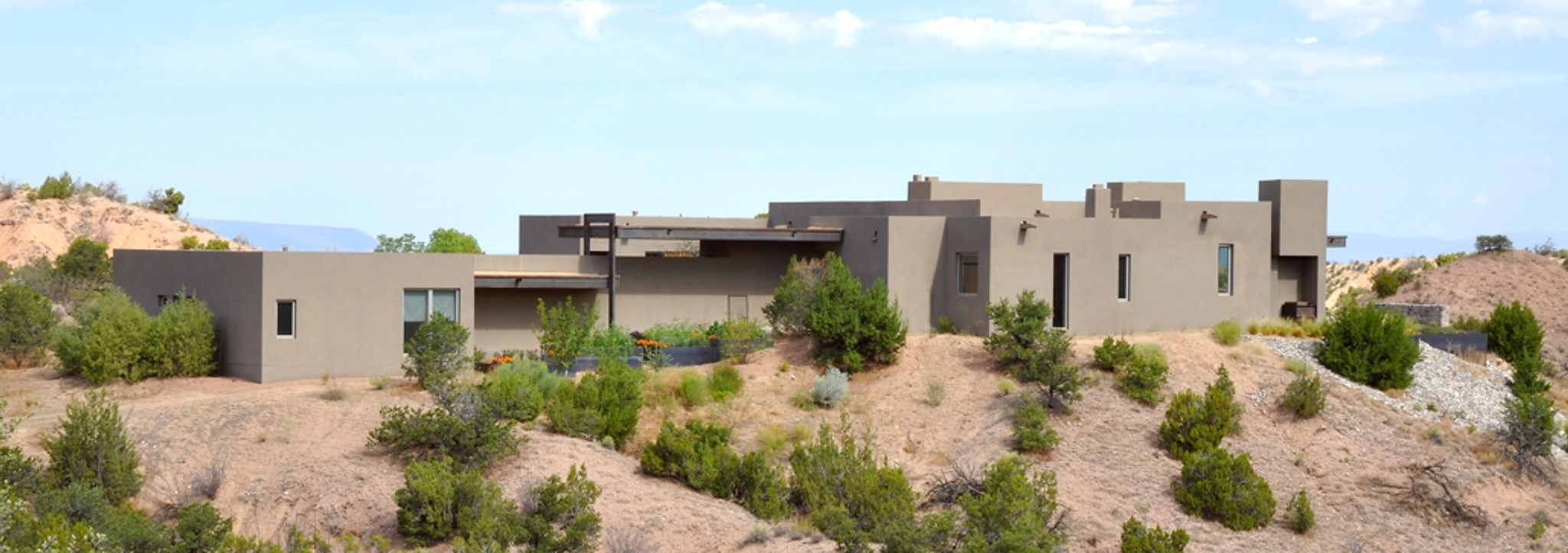
In Santa Fe, “modern architecture” is rarely a single idea. It’s a living discussion about proportion and texture, about how new construction should speak (or not speak) to the historic fabric around it, and about what “harmony” is supposed to mean when a city is both deeply traditional and unmistakably contemporary. That tension—creative momentum on one side, interpretive rules on the other—has been especially vivid in the work of architect Trey Jordan.
Jordan’s designs are often grouped into the broader conversation around Santa Fe Modern, a term that has moved beyond stylistic labeling and into cultural shorthand. His approach threads contemporary clarity through the region’s architectural vocabulary—thick-walled forms, shaded openings, and material sensibilities—while keeping the geometry disciplined and the overall effect calm rather than theatrical. That combination has made Jordan both influential and controversial, particularly when projects intersect with historic district review expectations.
Santa Fe’s Design Standard: “General Harmony” Meets Contemporary Ambition
Santa Fe’s historic districts operate with a specific visual philosophy: new work isn’t automatically dismissed, but it is evaluated through the lens of fit. The city’s own ordinance language has articulated the goal in terms of “a general harmony”—covering “style, form, color, height, proportion, texture and material” between historic and more modern design.1 The result is a design culture where architecture is interpreted not only for aesthetics, but for meaning: whether a building reads as part of the place rather than as an external imposition.
Within that framework, contemporary builders frequently run into a problem that’s bigger than any one façade: “modern” can mean either newer construction or a distinct architectural style with its own set of signals. In local debate, that distinction becomes a flashpoint because the historic ordinance—by design—tries to translate those signals into measurable categories like form, texture, and material relationships.1
Jordan’s work in the early-2000s landed in the center of that argument. His designs are not “historic replicas,” and they’re not minimal boxes either. They’re modern in form and design discipline, but they draw on local Santa Fe cues in the materials and details—so the building feels like a reinterpretation rather than a disruption. But in Santa Fe, interpretation has consequences.
Who Trey Jordan Is: Context-Driven Modernism With Northern New Mexico Roots
Jordan’s own design language is grounded in a few consistent ideas: integrity, responsiveness to context, and abstract references to Northern New Mexico vernacular. Jordan describes architecture that “responds to and draws from its context,” whether the project is in a historic district or on a rural property.2 The approach emphasizes preserving or responding to the historic fabric of existing architecture and landscape, and it frames his buildings as embodying “strength, simplicity, and stillness.”
That is less an aesthetic slogan than a set of design intentions. Jordan’s work is described in ways that align with how local architecture readers talk about form: crispness without aggressiveness, modern lines moderated by regional cues, and a palette that tends toward muted warmth rather than bright abstraction. Even when the building reads as contemporary, the underlying choices often feel engineered to meet Santa Fe where it lives—visually and climatically.
Jordan isn’t a one-off novelty entering a historic city — he’s been designing in Santa Fe for decades. He’s part of the longer arc of contemporary architecture learning, challenging, and iterating inside Santa Fe’s interpretive system.
The Early Flashpoint: When “Modern” Was Judged Against “Harmonious”
A key reason Jordan remains so widely discussed is that his work has been caught in the crosscurrents of Santa Fe’s historic review process—where the question is often not “Is it good?” but “Is it harmonious within this system?”
In reporting on Santa Fe’s Historic Districts Review process, coverage has framed the issue through the lens of ordinance language and the debate over what “harmonious” should mean in practice. One article quotes the ordinance’s goal of general harmony and discusses how disputes arise around modern proposals, including the characterization of Jordan as a polarizing figure.1
Other coverage has also described how Jordan’s work—and the broader question of contemporary deviation—became a “house-by-house” controversy, with residents reacting to projects that diverged from what many people expected a “classic Santa Fe” look to be.2
This matters because it clarifies what Jordan challenged. He wasn’t just offering a new style; he was pushing against an implicit boundary—how far modern architecture can go before it stops being legible as part of Santa Fe’s ongoing visual story. In a city where design decisions can feel like cultural decisions, that boundary becomes emotional as well as technical.
What Defines Jordan’s Aesthetic: Discipline, Vernacular Signals, and Light
If you strip away the debate and focus on Jordan’s architectural voice, his aesthetic tends to emphasize a few repeatable characteristics—qualities that architecture lovers can recognize even when the specific context changes.
-
Modern clarity softened by vernacular reading
Jordan’s designs are often described in terms that imply crisp edges and a controlled, contemporary composure—yet the work still carries the “Santa Fe grammar” through materials and familiar cues. -
A muted, high-desert palette and “quiet strength”
His firm’s own framing—“strength, simplicity, and stillness”—helps explain why his work doesn’t feel decorative for decoration’s sake. Even when the forms are unmistakably contemporary, the overall impression tends to be grounded and patient, designed to hold up against desert light instead of fighting it. -
Readable proportions and intentional openings
Santa Fe architecture is profoundly shaped by shade and opening relationships—where the building meets the outdoors, not only where it stands. Jordan’s approach repeatedly returns to that idea: contemporary form, but with the vernacular understanding that doors and windows are part of how the home is lived in. -
Stucco and traditional material logic, used with modern control
Jordan’s public and critical descriptions often link his work to recognizable Santa Fe material sensibilities—particularly stucco and the controlled way that surfaces and edges can articulate form. The point isn’t nostalgia. It’s translation: familiar materials used to make contemporary architecture feel materially coherent in the New Mexico landscape.
For buyers and architecture lovers alike, this is the difference between novelty and adaptation. Jordan’s work isn’t simply modern in appearance; it’s modern in its method of belonging.
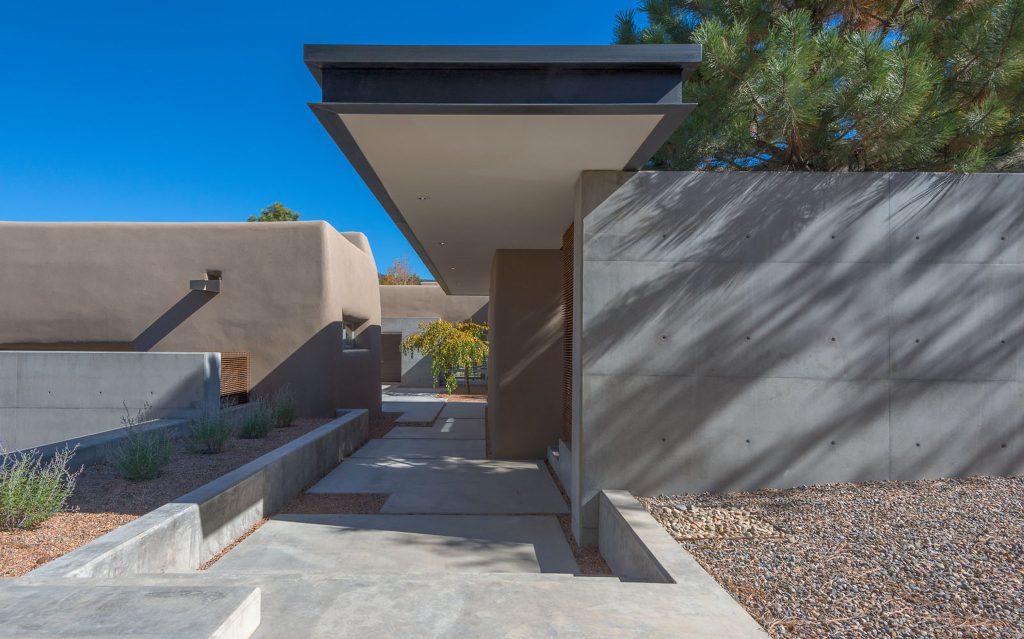
Photo courtesy of Trey Jordan
“Santa Fe Modern” Becomes a Category (Not Just a Dispute)
Over time, the Jordan conversation has shifted from “Is this allowed?” to “How does this interpret Santa Fe?” That shift is visible in cultural coverage that treats the modern conversation as a broader architectural movement—one shaped by climate, history, and the city’s relationship to modernism.
Local and national arts coverage has highlighted how projects captured in “Santa Fe Modern” literature link the region’s traditional forms to modern applications, describing the movement’s lineage and influence rather than treating it as an isolated provocation.2 In other words: modernist thinking here isn’t framed as a break—it’s framed as an evolution of how local architecture can be understood.
Meanwhile, TABLE Magazine has discussed the modern conversation through interviews tied to Santa Fe Modern and related features—placing Jordan’s work in a context where it’s treated as part of an ongoing architectural language.
This is also where “acceptance” (in the sense of cultural normalization) can be discussed responsibly. Not every individual dispute disappears, but the framing does change: the work becomes more legible as a coherent category within Santa Fe’s contemporary architectural ecosystem.
For Architecture Lovers—and for Buyers: The Right Question Isn’t “Fit” Alone
The temptation in real estate and design discourse is to reduce everything to a binary: it belongs or it doesn’t. But Jordan’s career suggests a more interesting and more accurate lens: the real question is how contemporary work interprets the landscape, the climate, and the logic of the local, familiar architectural language.
In Santa Fe, a home’s architecture performs multiple jobs at once. It must read well on a street and in a historic district context. It must hold up to desert weather and intense light. And it must participate in the town’s visual story without erasing it. Jordan’s work—often described through the twin ideas of context responsiveness and modern discipline—sits at the intersection of those responsibilities.
For architecture lovers, Jordan offers something rarer than a single “style”: a framework for thinking about modernism in a place that demands interpretation. For buyers searching for contemporary homes in Santa Fe, that framework becomes practical. It encourages evaluation beyond surface taste—toward proportion, material coherence, opening strategy, and how the building is likely to feel across seasons and daylight.
Ready to explore?
If you’re exploring contemporary homes in Santa Fe—whether as an architecture enthusiast, a relocating buyer, or someone planning a build—FORM Santa Fe can help you explore the market with confidence. With a passion for architecture and a client-first approach, we connect local design context to real buying and selling strategy—so your next move reflects both your goals and the realities of the Santa Fe landscape. Contact us today to start the conversation.
References: